teaching staff
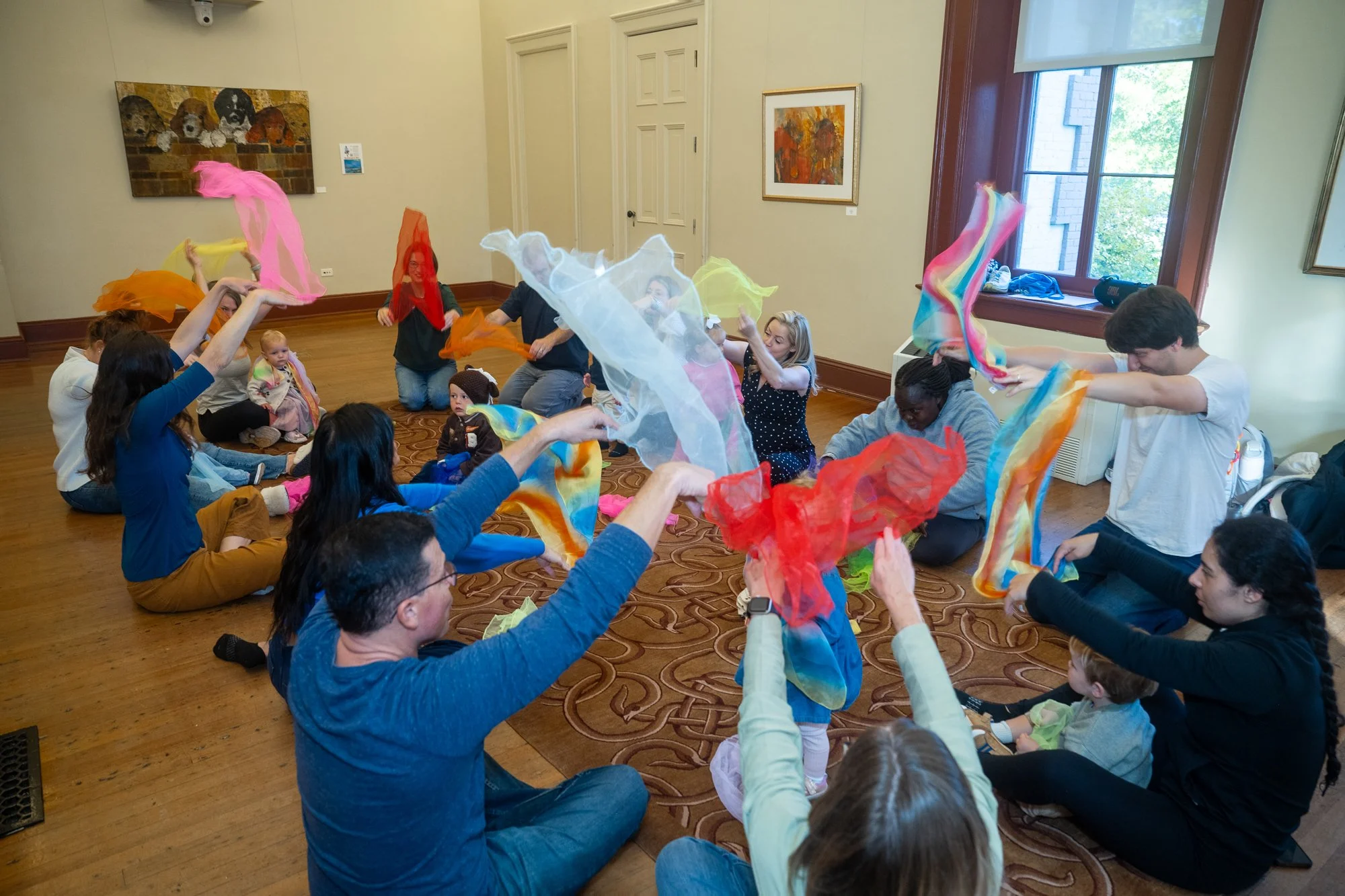
The family is always the hero. The teacher is always the guide.
Michael Showalter
A family senses the early years matter but can’t find a music experience that treats them as participants, not spectators. Most children’s programs aim entertainment at kids while adults sit on the sidelines. Underneath that: the parent is afraid they’re not musical enough to matter in the room.
Mike grew up in a family where music was something people made together. He assumed that was normal. When he discovered it wasn’t, he felt disappointed—not for himself, but for the families who had lost something they didn’t know they were missing. Fifteen years singing in DC’s finest choral ensembles taught him that music works when every voice carries a part. He built Mister Mike’s Music on the belief that music-making is a birthright, not a talent.
“I saw it in my own children’s faces. This music offered something richer—something parents could genuinely be part of without any formal training.”
In his classes, adults sing harmony, work through hand dances that small children won’t master for years, and carry real musical responsibility. Without that model, children grow up believing music belongs to someone else. With it, songs show up at the dinner table, in the car, at bedtime. Music becomes something your family makes, not something you consume.
Libby Quaid
A new parent is overwhelmed and craving something meaningful to do with their child. They remember loving music but haven’t sung in years. They feel self-conscious—like they need to be “musical” to participate.
Libby understands that hesitation because she lived it. She grew up playing piano and clarinet in a family of singers, built a career as an award-winning education journalist at the Associated Press, and discovered Music Together as a parent. What surprised her was how much she needed it herself. She knows what it feels like to hold back, and she knows what changes when you stop. A parent doesn’t need special training to be their child’s most important musical model.
“A parent doesn’t need special training to be an enthusiastic participant. I want to show children that anyone can sing and dance and enjoy music.”
In her classes, she draws hesitant adults into the music with warmth and humor until they realize they’ve been singing without thinking about it. Without that invitation, the parent stays on the sideline and the child learns music is something other people do. With it, the parent rediscovers something they thought wasn’t for them, and music becomes a shared language at home.
Stephen Leroy
A family wants a rich musical experience for their child, not singalong entertainment. The parent may have their own musical interests but sees children’s music as simpler and less interesting. They haven’t considered that a music class could challenge them too.
Stephen came to Music Together as a bass guitarist, Georgetown-trained linguist, and father—not as a prospective teacher. His recordings have been heard in films and on radio. He has long been fascinated by how people learn music. He came to understand the curriculum for his own children. One demo class changed that, because he saw what happens when adults and children make music together instead of separately.
“When adults participate alongside their children, music stops being something we hand down and becomes something we share. That changes what a child understands about who music belongs to.”
In his room, he brings guitar, ukulele, banjo, and bass—but uses them to pull families into the music rather than performing for them. Without that, the parent outsources music and watches from the side. With it, the parent discovers this music is more sophisticated than they expected—and that they’re part of making it.
Deborah Silverman
A family new to the area or to parenthood is looking for community. They want warmth and acceptance, especially if their child is shy, wiggly, or still figuring out group settings. They worry they’ll be judged for their child’s behavior.
Deborah’s musical life has always been participatory—cello, piano, musical theater, and a local klezmer band. She experienced Music Together from both sides, attending classes with her son Zev before becoming a teacher. She knows what it feels like to walk into a room hoping your child will cooperate and discovering that cooperation isn’t the point.
“I love giving parents the opportunity to be musical models for their children. Everyone is musical. Parents will always be the best teachers for their own kids.”
In her room, her energy and experience draw adults into the music naturally. No one watches from the edge. Without that welcome, the family stays isolated and keeps searching. With it, they find their community, and the child grows up inside a musical group where they’ve always belonged.
Hunter Ringsmith
A family—especially one with a dad or partner who feels awkward about singing—wants to participate but doesn’t have a model for what that looks like. Singing and moving in front of other adults feels exposing.
Hunter is a trained actor and singer with degrees from SMU and UC Irvine, including work at Folger Theatre. He knows what it means to connect with a room. But he channels that training toward making families feel safe enough to join in, not toward performing for them. Music is something everyone carries with them, not something reserved for spotlights.
“Music is a lifelong pursuit, and it starts with the people closest to you choosing to make it together. When adults sing, children learn that music is theirs too.”
In his classes, his playfulness makes participation feel natural before you have time to feel awkward. Without that model, the self-conscious adult opts out and the child sees a parent who watches. With it, the adult who came in stiff leaves singing in the car, and participation becomes the family’s default.
Lisa Petrone
A parent who cares about their child’s development wants something with real educational substance, not just fun. They may be a former educator themselves. They’re skeptical a children’s music class could be rigorous enough.
Lisa earned a clarinet scholarship in college, studied education and Spanish, spent three years in Spain as a Fulbright Scholar, and taught fourth-grade Spanish immersion for eight years. She still plays with the Fairfax County Wind Symphony. She discovered Music Together during the pandemic and recognized immediately that the program was built on real pedagogy—not just good vibes.
“It’s not just singing around children and hoping they join in. It’s intentional. And when parents are genuinely part of it, you can see what changes in a child.”
In her room, she brings an educator’s instincts and a musician’s ear. She builds participation steadily, never rushing families who are finding their way in. Without that substance, the family chooses something flashy that entertains but doesn’t build a foundation. With it, the parent sees real depth in their child’s musical development—and realizes the program challenges them too.
Susanna “Suzie” Corona-Esparza
A family wants their child to experience music but may carry assumptions about what “musical” means—that it requires hearing, singing on pitch, or innate talent. They may be a hearing family curious about sign language, or a deaf family looking for a space where music is truly accessible.
Suzie is profoundly deaf. She experiences music through rhythm, vibration, and movement. She holds a degree in Family Studies and Spanish from Gallaudet University and has spent more than fifteen years working with families and young children in Capitol Hill. Her presence in the room reframes everything a family thinks they know about who music belongs to. Music lives in the body, not just the ear.
“How can a deaf person teach music? The same way anyone makes music—with their whole self. Music is rhythm, vibration, expression. When families sign and move together, they discover music was never just about hearing.”
In her classes, she teaches songs through sign language, gesture, and facial expression. Every family uses their hands, faces, and bodies to make music. Without that reframing, the child grows up with a narrow definition of who gets to be musical. With it, the family discovers that music is bigger than sound—and the child grows up knowing music belongs to every body.
Linda Steele
A family—possibly multilingual or multicultural—wants a music experience that feels welcoming across backgrounds and honors musical quality without being performance-focused. They may associate music with audiences and stages rather than participation.
Linda has been singing since she was three. She has toured internationally, performs in five languages, and won Taiwan’s Top Idol in 2006. She knows what it means to connect with a room through music. But a stage is not a circle. She discovered Music Together with her own daughters and found something her performing career hadn’t prepared her for: making music with her children rather than for an audience.
“On stage, the music goes one direction. In the circle, it moves between everyone. When I saw my own children light up because we were singing together—not because I was performing—I understood what this was really about.”
In her classes, her voice and musicality are unmistakable, but she directs them outward to lift the room, not lead it. Parents sing more boldly because she makes it feel safe to try. Without that, the family stays in the audience and music remains something experts perform. With it, the child grows up hearing music as something their family makes.
Miriam Koby
A family wants their child to have a strong musical foundation but isn’t sure what that looks like at such a young age. They want depth, not nursery rhymes. They don’t yet realize that the most powerful musical foundation at this age isn’t technical—it’s participatory.
Miriam’s own musical life started in early childhood music classes just like these. She went on to Oberlin Conservatory, a master’s at the University of Maryland, and performances with Wynton Marsalis and Yo-Yo Ma at Carnegie Hall. She performs with the Fairfax Symphony Orchestra. She knows what music sounds like at the highest level. She also knows where it started for her: in a room full of families, singing.
“There’s something about this space that my performance life doesn’t give me. Here, I get to use my voice, move, have fun, and share it. The music belongs to everyone in the room.”
In her classes, she brings a deep musical ear and natural warmth with young children—seriousness without formality. Without that early start, the family waits until the child is “old enough” for lessons and the participatory window closes. With it, the child builds a musical foundation through immersion, and the family discovers the most important thing they can do is participate.
Ellen Kliman
A family with experience or high expectations is looking for a teacher with real depth. They want someone who takes the music seriously without making the room feel like a lesson. They worry a children’s music class will feel shallow.
Ellen holds degrees from Oberlin Conservatory and the University of Maryland. She performs opera, cabaret, early music, and chamber music across Washington, and sings weekly as a soloist at All Souls Episcopal and St. Matthew’s Cathedral. But her first love has always been education—more than twenty years running a private music studio. She first walked into a Music Together class in 2008 with her oldest son, was hooked immediately, and has experienced the program as a new parent, a returning parent, and a teacher.
“I came to Music Together because I wanted to share music with my son. I stayed because I saw what happens when the whole room participates. The adults aren’t watching. They’re singing. And the children grow up inside that.”
In her classes, you’ll find a trained ear and two decades of teaching instincts. She brings depth without making the room feel like a lesson. Without that, the family settles for something shallow. With it, the parent is genuinely challenged, and the child grows up watching their parent take music seriously and joyfully.
Mari Carlson
A family is looking for something grounded and unpressured. They may be new to music classes or have tried something that felt too performative. They’re hesitant. They’re not sure they belong.
Mari has played violin since she was three but never planned a music career. She studied religion at St. Olaf College and pastoral care at St. Paul’s Seminary. But music kept being the thing she came back to. More than twenty years teaching privately and performing in bluegrass, folk, and classical chamber groups. That trajectory means she understands music the way most families experience it—not as a profession, but as something you can’t stop doing.
“Music doesn’t wait for you to choose it. It’s already there. When families make music together, they’re not learning something new. They’re returning to something they already have.”
In her classes, her patience and steadiness make the space feel safe. She meets families wherever they are. Without that safety, the family stays home because they don’t feel musical enough. With it, the hesitant parent finds their way in, and the child grows up knowing that music doesn’t require talent—it requires participation.
Brenna Winslow
New parents are often looking for something that isn't just baby-tolerating but actively baby-friendly. Sometimes, parents in the exact same stage suspect a music class is meant for families who are already "musical," and are not sure that's them. Underneath it they might worry that you have to be a singer to belong in our classes.
Brenna knows that feeling, because it's how she walked in. She grew up singing in church, in musical theater, and in a band with her sisters. But she came to Music Together as a new mom, not a performer. A friend in her parent group rallied a few of them to sign up together, and class quickly became the anchor of her week. She watched her son Perry take his first steps in one of those classes. She isn't a professional singer, and that's exactly the point.
"I may not be a professional musician, but I love to sing and dance with my kid whether I sound 'good' or not. That's what I want parents to see: that this belongs to them too."
Because she came up through the program as a parent, she knows what a tired new family is feeling. During free dance she nudges parents to bring in the songs they already love. That's where bonding happens, and the class changes from a group of individuals into a community of people in the same place in life. When she teaches a "babies" class, she knows what's going on at home and reminds exhausted parents that they will sleep again one day soon. With that reassurance, new parents find the songs and the other parents in the trenches with them, and discover they were musical all along.
My daughter attended the Winter semester of Mr. Mike's Music and Ms. Libby was her teacher. We had an excellent experience with Ms. Libby. She was always engaged and focused on the kids during the class. She was warm, welcome and treated everyone — child and parent — with absolute respect and kindness. I really thought the repetitiveness of the class throughout the 10 weeks is what helped my daughter the most. The songs were simple, but each one taught a lesson. My daughter looked forward to going every week. Thank you so much, Ms. Libby and Mr. Mike for such a wonderful experience. We will be back!
— Ashley Westerman Loboda