
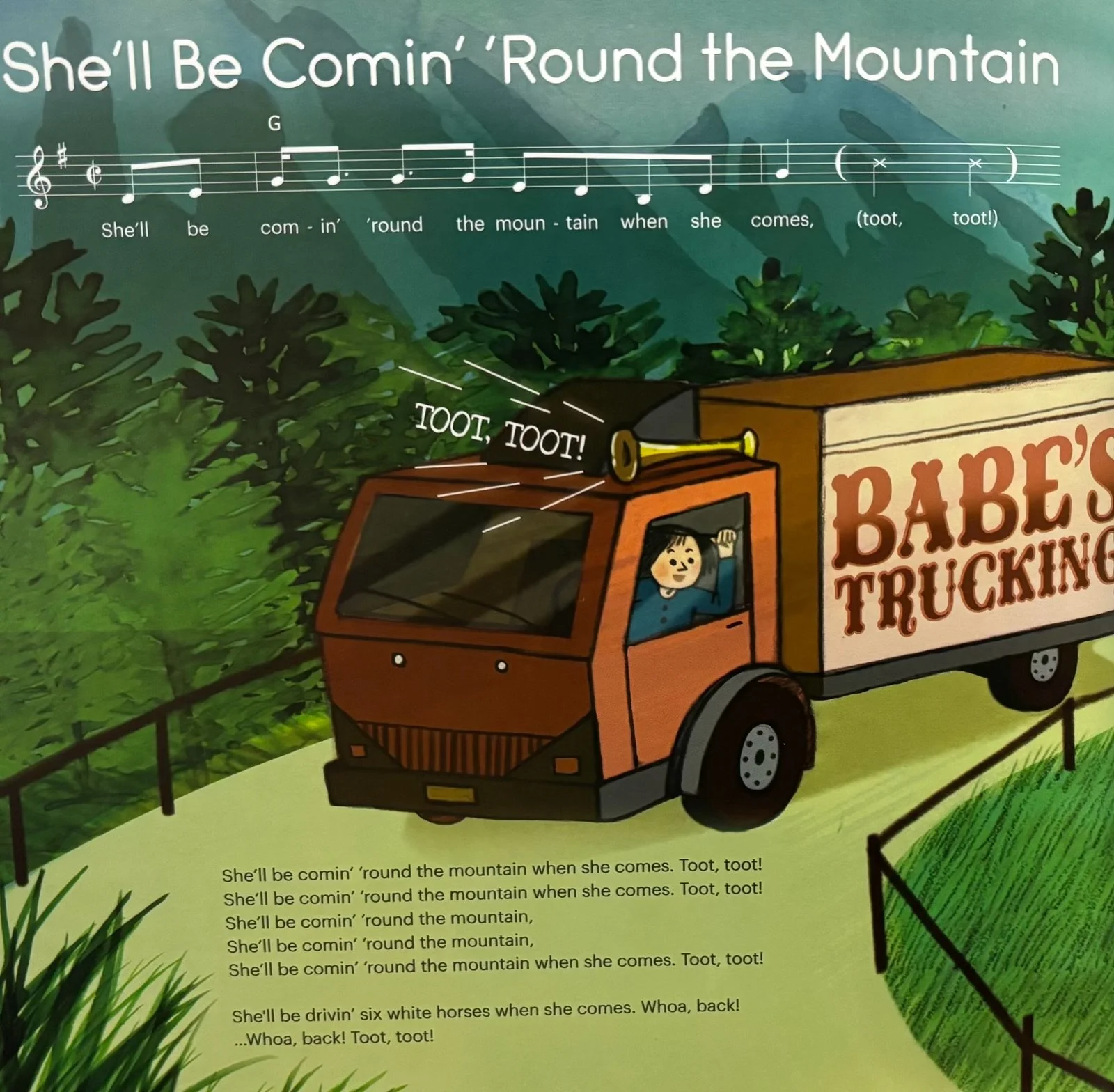
One of the songs in Bongos is a perennial favorite. You've sung "She'll Be Coming 'Round the Mountain" with us in class. It's a song you probably knew before the semester, and hopefully you've sung it at home many times. Madelyn Ross from Deborah's Sunday class, whose family was featured last month in Family Notes, told us it's one of her son Avi's favorites. He asks for it again and again and Madelyn now hears little yee-haws and whoa backs coming from the backseat of the car.
In this song, each verse adds a new sound and motion, and then everyone repeats all the ones that came before it. In the version in the Bongos Song Collection, the first verse ends with "toot toot." The next verse adds "whoa back," so you sing "whoa back, toot toot." If your child comes to class with their nanny and you've wondered why they're making these sounds at home, this is where they come from.
This song is much older than any of us. It grew out of a spiritual called "When the Chariot Comes," which was sung to the same melody and first printed over 125 years ago.
Then railroad workers in the Midwest took the tune and gave it new words. The poet Carl Sandburg printed "She'll Be Comin' Round the Mountain" in his collection The American Songbag. Verses like the pink pajamas were probably added later, as it became a campfire sing-along. That's how a folk song gets passed along. Nobody owns the words, so every group that sings it gets to add something, just like we do in class.
There is a reason this old song has lasted so long. It's a game, and people love it because it's silly and fun to try to build more verses until it reaches an unsustainable length. Underneath the fun, it's built in a way that makes remembering easier, and it gives everyone, from the youngest child to the grownups, a job they can do from the very first verse.
A cumulative song is a memory game set to music. Every verse hands us one new piece and then walks us back through everything we already know. Each time through, all of us are practicing order: what comes first, what comes next, and what comes last.
It's also a sneaky way for us music teachers to get people singing who don't think of themselves as singers. When you're trying to remember what comes after "whoa back," you stop worrying about your singing voice. It doesn't feel like singing. It feels like playing a game. Before you know it, you've sung the whole song without noticing, and your child thinks singing is just a normal way to have fun with their family.
Songs like this turn up in many traditions. Many Jewish families sing "Chad Gadya," and children everywhere know "There Was an Old Lady Who Swallowed a Fly." Another favorite this time of year is "The Twelve Days of Christmas." Each day adds one new gift, and you sing your way back down to the partridge in a pear tree. My family sings this every year. In fact, growing up, my mother had a set of eggnog glasses, each with a different gift from the song. It's best sung after several eggnogs.
Whatever your family sings this season, sing it together. All singing is good singing. A cumulative song simply adds a hidden bonus. While we're laughing and waiting for our favorite part, we're all getting a little brain exercise. We're memorizing some crazy list, keeping it in order, and waiting for our turn to add our part.
The best part of a cumulative song is that you can keep building it. Sing the verses you know from class, and then take turns inventing the next one. Maybe she'll be riding on a scooter, and the sound is "beep beep." Maybe she'll be hacking away at snowcrete, and the sound is "chip chip." Add as many new verses as you can. It's the most fun when someone forgets and the whole thing falls apart.
You can do this anywhere. A song with made-up verses can't come from a recording. It only comes from the voices of togetherness.
The years before five go quickly, and so much of what we do with young children happens next to them rather than with them. A song like this one is different. It needs everyone. The grownup holds the sequence, the child adds a new piece, and together you build something neither of you could sing alone. Whether your family is counting partridges this season or shouting "toot toot" from the backseat, this is what families do together.
There's room for your family. Come sing with us at mistermikesmusic.com.
